
Voice-coil actuators: precision motion from a loudspeaker's trick
Inside every loudspeaker is a motor reduced to its essence: a coil of wire sitting in a magnetic gap, pushed back and forth by the current in the coil. That is the entire mechanism, and it is so good at what it does that engineers borrowed it wholesale. The voice-coil actuator, named for its audio origins, now moves hard-drive heads, focuses camera lenses and positions semiconductor wafers.
Force straight from current
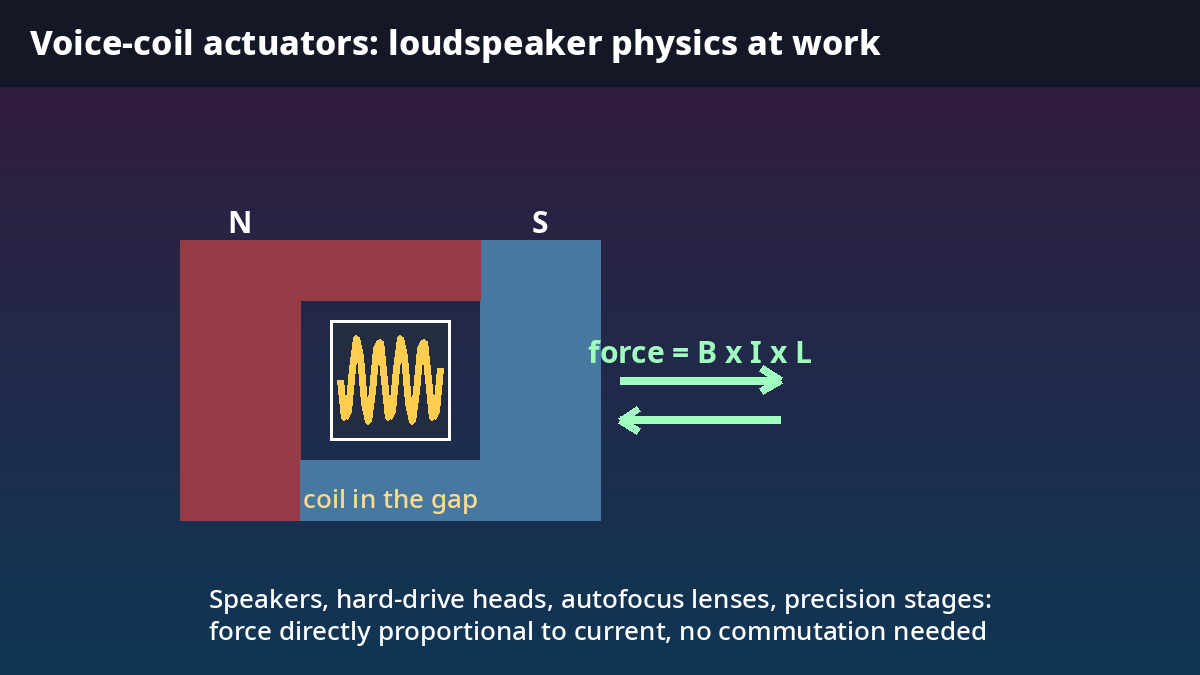
The physics is the Lorentz force: a conductor carrying current across a magnetic field feels a force perpendicular to both. A voice-coil actuator arranges a radial magnetic field across an annular gap, using a permanent magnet and soft-iron pole pieces, and places a cylindrical coil in that gap. The resulting force along the axis is simply proportional to current, with the magnet and gap geometry setting the constant of proportionality. No commutation, no cogging, no hysteresis in the drive itself: double the current, double the force, reverse the current, reverse the force.
Why precision engineers love them
The direct proportionality is the attraction. There are no brushes to spark, no screw to introduce backlash, no detent positions to fight. With a position sensor and a control loop, a voice-coil stage settles to micron and even sub-micron accuracy in milliseconds, over strokes from a few millimetres to several centimetres. The coil is the only part that needs to move, and it can be made almost massless, so accelerations are enormous relative to size.
Where they hide
The loudspeaker remains the highest-volume application by far: the voice coil in its magnet gap, pushing the cone that pushes the air. Hard disk drives swung their read heads with voice-coil actuators for decades, seeking across a platter in milliseconds. Phone cameras focus and stabilise their lenses with voice-coil micro-actuators a few millimetres across. Optical benches, laser scanners, medical dosing pumps and vibration-test shakers all use the same architecture, as do the active-cancellation stages that hold lithography optics still.
The limits
A voice coil gives force, not position: with no power, it holds nothing, so vertical axes need counterweights or brakes. Stroke is short, since force collapses once the coil leaves the gap. And all the input energy becomes heat in the coil, which is why continuous-force ratings run well below peak. The coil design itself is the usual winding trade, covered in our skin-effect piece at one extreme: self-supporting coils wound from enamelled wire and bonded, with every gram and ohm argued over.
The enduring idea
Few electromechanical ideas have colonised as many industries with as little modification. A gap, a magnet, a coil, and a force that obeys the ammeter: when a machine needs to move something small, fast and exactly, the loudspeaker's trick is still the first answer.