
Skin effect and proximity effect: why high-frequency current avoids the middle of the wire
Pass direct current through a round copper wire and every square millimetre of the cross-section carries its share. Pass alternating current through the same wire and something odd happens: the current migrates toward the surface, leaving the centre of the conductor doing less and less useful work as the frequency rises. This is the skin effect, and in coil design it quietly decides how thick a wire is allowed to be.
What causes it
An alternating current creates an alternating magnetic field around and inside the conductor. That changing field induces eddy currents in the conductor itself, and those eddy currents oppose the flow in the centre more than they oppose it near the surface. The net result is a current density that is highest at the surface and falls off exponentially toward the middle.
Engineers describe the falloff with a single number, the skin depth: the distance from the surface at which the current density has dropped to about 37 percent of its surface value. For copper the skin depth is roughly 8.5 mm at 60 Hz, about 2.1 mm at 1 kHz, near 0.5 mm at 20 kHz and only about 0.2 mm at 100 kHz. Mains-frequency windings barely notice the effect; a switch-mode transformer running at 100 kHz lives inside it.
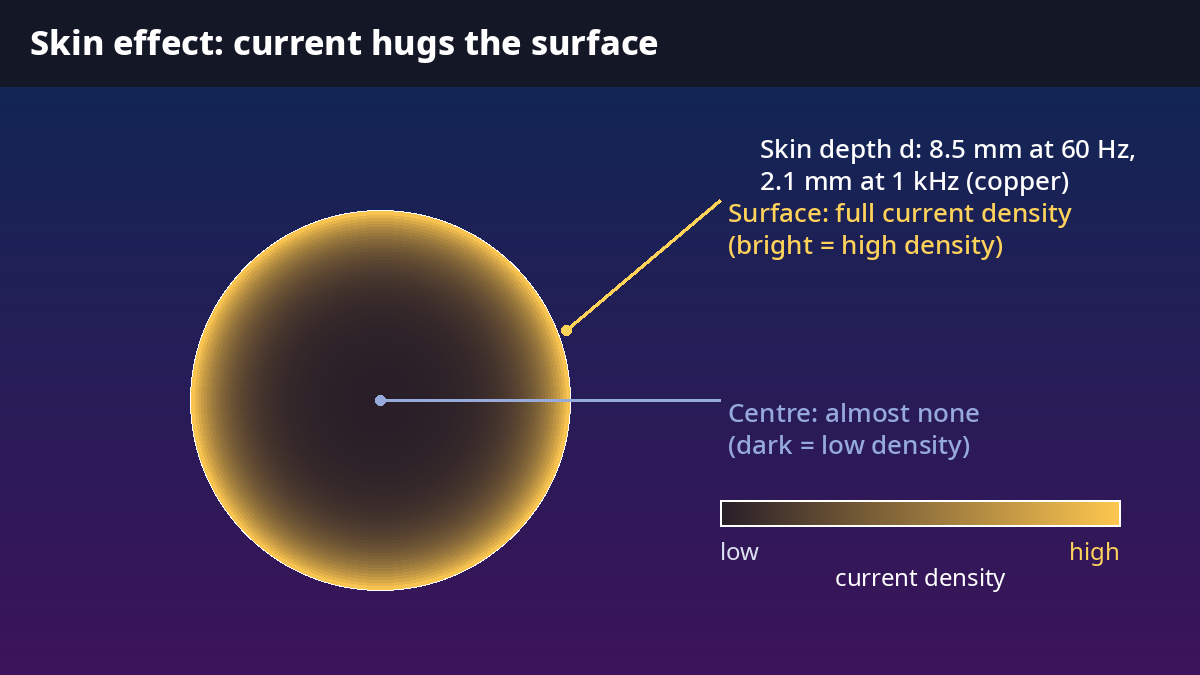
Why the middle of the wire still costs money
The practical consequence is that a thick conductor at high frequency has an AC resistance far above its DC resistance. The copper in the middle is paid for, wound and carried, but it carries little current. Designers therefore treat skin depth as a size limit: once a strand is much thicker than two skin depths, adding more diameter buys almost nothing.
Proximity effect: the neighbour problem
A winding is not one isolated wire. It is hundreds of conductors packed side by side, each sitting in the magnetic field of its neighbours. Those external fields distort the current distribution too, pushing the current onto one side of each conductor. This is proximity effect, and in a multi-layer winding it can raise losses far more than skin effect alone. The losses grow steeply with the number of layers, which is why high-frequency transformer designs often interleave primary and secondary or reduce layer count even when a simpler winding would fit.
What designers do about it
The countermeasures all increase useful surface area. Thin foil conductors work well in some transformer layers. Several smaller wires in parallel help a little. The most complete answer is litz wire, which divides the conductor into many insulated strands thinner than the skin depth and weaves them so each strand takes its turn at every position in the bundle. And where a single solid conductor must carry high-frequency current, as in busbars and large coils, designers simply accept a hollow or flattened shape, because the middle was never going to help anyway.
The takeaway
Skin effect is not a defect; it is physics doing what it does. Good winding design treats skin depth as a ruler: size conductors to it, watch the layer count, and choose stranding or foil when the frequency demands it.