
Eddy currents: the reason transformer cores are made of paper-thin steel
Open any mains transformer and the core looks like a book: hundreds of steel sheets, each a fraction of a millimetre thick, stacked and clamped into shape. It is a strange way to build a lump of metal. The reason is an invisible current that would otherwise turn the core into a heater: the eddy current.
The core as an accidental winding
A transformer works by swinging magnetic flux through its core. But the core is conductive, and any loop of conductor enclosing a changing flux has a voltage induced in it, exactly as if it were another turn of the winding. In a solid core, enormous loops are available: current can swirl through the whole cross-section. Those swirls are eddy currents, named for the way they circle like eddies in water, and they dissipate power as heat in the steel. A solid-core mains transformer would waste a large fraction of its input power cooking its own core and would run hot at no load with nothing connected at all.
Slicing the loops
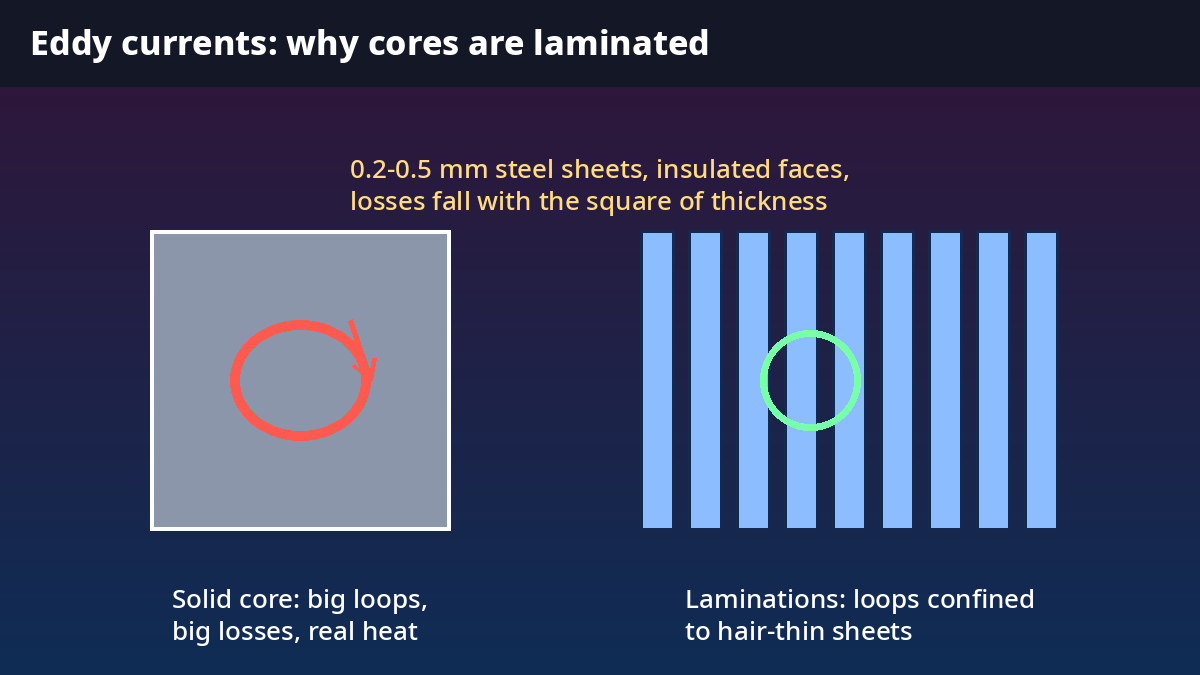
The fix is geometry. Cut the core into thin sheets whose planes lie along the flux path, coat each sheet with a thin insulating layer, and the available loops shrink to the width of one lamination. The induced voltage per loop drops with the smaller enclosed area, and the resistance of the long, thin path rises, so the current collapses. Eddy-current loss falls with the square of the lamination thickness, which is why mains transformers use sheets around a quarter to half a millimetre thick, and higher-frequency transformers use thinner still, down to hundredths of a millimetre for audio and aerospace work.
The steel itself fights too
Lamination is only half the defence. Transformer steel is silicon steel, alloyed with a few percent of silicon, which raises its electrical resistivity several-fold and further chokes the eddies. The sheets are also grain-oriented: heat-treated and rolled so their crystal grains point along the flux path, cutting the other core loss, hysteresis, the energy spent flipping the steel's magnetism back and forth every cycle. Eddy and hysteresis losses together make the core loss that a transformer's no-load test measures.
Beyond sheets
As frequency climbs, even thin steel loses the argument. Ferrite ceramics, essentially magnetic insulators, carry almost no eddy current at all and dominate switch-mode magnetics above a few tens of kilohertz. Powdered iron and amorphous metal cores fill other niches. The choice of core shape and the choice of core material are two answers to the same question: how to let the flux through and keep the current out.
The shop-floor echo
Lamination has a winding-room consequence: burrs, damaged coating or a bolt shorting across the stack recreate the very loops the sheets were meant to break. A surprising amount of transformer rework traces to such interlaminar faults, local hot spots found by a thermal camera or a core-loss test. The stack of paper-thin steel is not packaging; it is the component.