
Toroidal or E-core: two shapes that divide the transformer world
Ask a winding shop to build a small transformer and one of the first questions is the core shape. The two dominant answers are the toroid, a closed ring of core material with the windings threaded through its centre, and the E-core, a stack of E-shaped laminations whose centre limb carries a ready-wound bobbin. Both appear everywhere from audio amplifiers to industrial control panels, and they represent a genuine engineering trade.
The toroid: magnetically tidy, awkward to wind
A toroidal core has no ends and no joints. The magnetic flux travels in a continuous ring, so the core can be worked closer to its limits and very little field escapes into the surroundings. That low external field is why toroids are favoured in audio equipment, where a stray hum field modulating a sensitive signal path is unacceptable, and in compact medical and test gear. With no air gaps and no loose laminations, a well-made toroid also runs quietly, with little of the buzz that loose laminations can produce.
The price of this tidiness is paid at the winding machine. Wire cannot be pre-wound on a bobbin; it must be passed through the centre of the ring, turn by turn, with a shuttle or needle carrying the wire around. As transformer winding practice shows, that means dedicated toroidal winding machinery, slower builds and practical limits on wire size. Many turns of thick wire around a small ring is simply not economical.
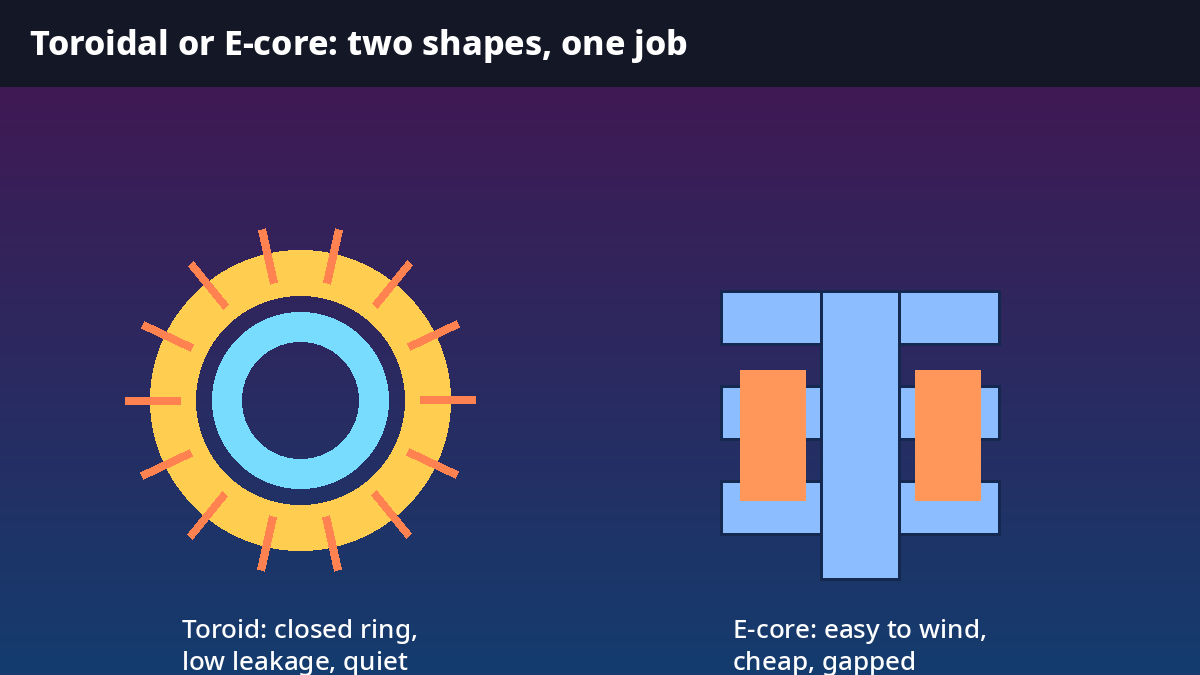
The E-core: built for the production line
An E-core transformer inverts the logic. The coil is wound first, on a bobbin, on fast conventional winding machines of the kind described in our coverage of coil winding machinery. The laminated core is then assembled through the bobbin: E-shaped and I-shaped stampings interleaved from alternate sides, or E-E pairs clamped together. Winding is cheap, quick and easy to automate, and the bobbin gives clean creepage distances for safety isolation.
The compromises live in the magnetic circuit. Every joint between laminations is a tiny air gap that adds leakage and no-load current, and the sharp corners of the core window force the flux path to turn, using the steel slightly less efficiently than a ring does. The external stray field is higher, which matters in sensitive electronics, and loose or poorly clamped laminations can hum audibly at twice the mains frequency.
Choosing between them
The decision usually falls out of priorities. Lowest possible hum and leakage field, smallest size and weight for a given rating, and modest production volumes point to the toroid. Lowest unit cost, high volumes, thick wire, many taps or secondaries, and straightforward safety compliance point to the E-core. Neither is universally better; the industry uses both precisely because the trade-offs differ.
Beyond the two classics
The same logic extends to other shapes. C-cores and cut toroids keep a near-closed path while allowing the core to be assembled around a finished coil. Planar transformers replace wound wire with flat copper spirals in printed circuit boards, trading copper volume for a thin profile. Each is another answer to the same question the toroid and the E-core answer differently: how to guide a magnetic field through copper with the least waste of space, material and effort.