
Brushed versus brushless: what really changes when the brushes disappear
Every DC motor faces the same problem: the current in the rotor windings must reverse direction every half turn, or the torque would reverse too. For more than a century the answer was the commutator, a segmented copper ring wiped by carbon brushes. The brushless DC motor keeps the physics and deletes the sliding contacts, and that one change reorganises the whole machine.
The brushed layout
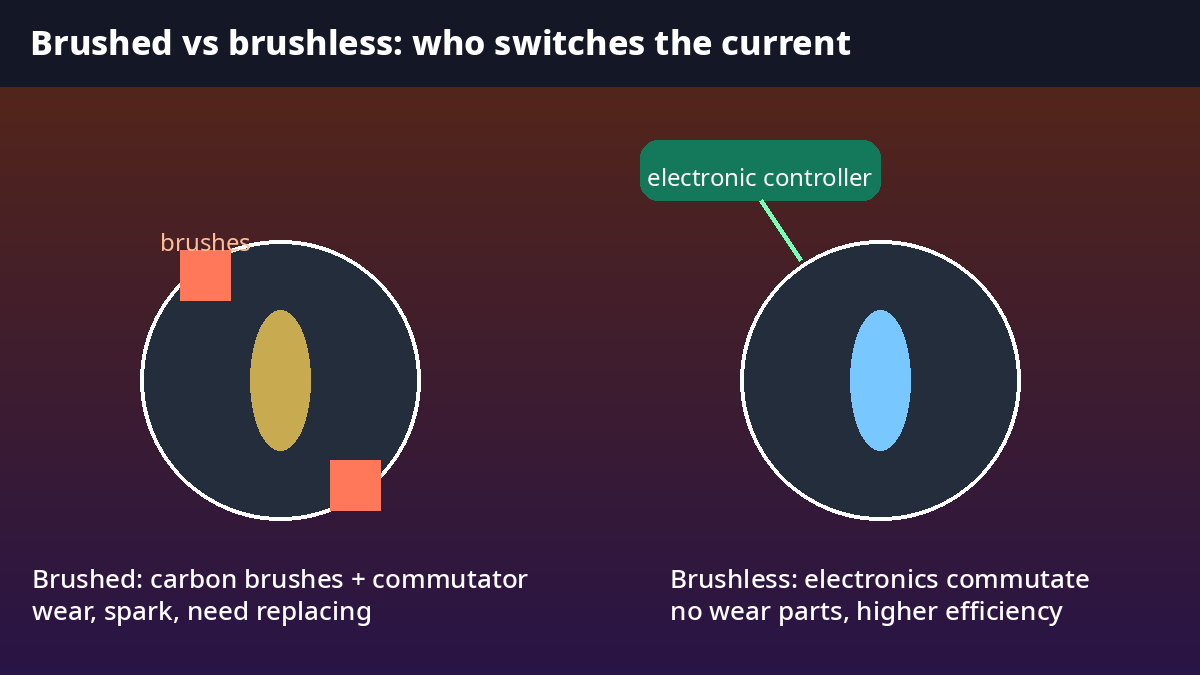
In a conventional brushed DC motor the windings sit on the rotor and the magnets are stationary in the housing. As the rotor turns, the commutator segments pass under the brushes, switching each coil's current at exactly the right angular position. The design is simple, cheap and needs no electronics: apply DC voltage and it runs. Small tools, toys, car window lifters and starter motors still use it by the million.
The weaknesses all trace back to the sliding contact. Brushes wear, producing conductive dust, and eventually need replacement. The interface sparks, creating electrical noise and limiting voltage. Friction and brush drop waste a few percent of the input power, and the commutator caps the practical speed.
The brushless layout
A BLDC motor turns the arrangement inside out. The permanent magnets move to the rotor and the windings move to the stationary stator, where they are easy to cool and need no sliding connections. The commutation job moves to an electronic controller that senses rotor position, by Hall sensors or by reading the back-EMF in an unpowered phase, and energises the stator phases in sequence. The winding itself is a close relative of the stator windings covered in how motor stators are wound, and the same winding quality issues apply.
What improves
Removing the brush-commutator interface removes its losses and its wear. Brushless motors commonly run several points higher in efficiency, run quieter, produce less electrical noise and last as long as their bearings do, often tens of thousands of hours. With the windings bolted to the housing, heat has a short path out, so a BLDC can be pushed harder for its size. Speed ceilings rise too, since nothing slides.
What it costs
The motor is only half the system. A BLDC needs its controller to run at all, so the comparison is really motor-plus-electronics against motor-alone. The controller adds cost, design effort and its own failure modes, and sensorless starting at very low speed takes finesse. Brushed motors keep their niche wherever simplicity, low parts count and instant reversibility matter more than service life.
Where each wins
The market has voted by application. Drone propulsion, computer fans, cordless tools, e-bikes and electric vehicle traction are brushless territory, where efficiency and lifetime dominate. Automotive auxiliary motors, cheap toys and simple appliances stay brushed, where a worn-out brush pair outlives the product anyway. The physics is the same on both sides; only the switching, and everything it drags with it, has moved.