
How electric motor stators are wound: needle, flyer and hairpin
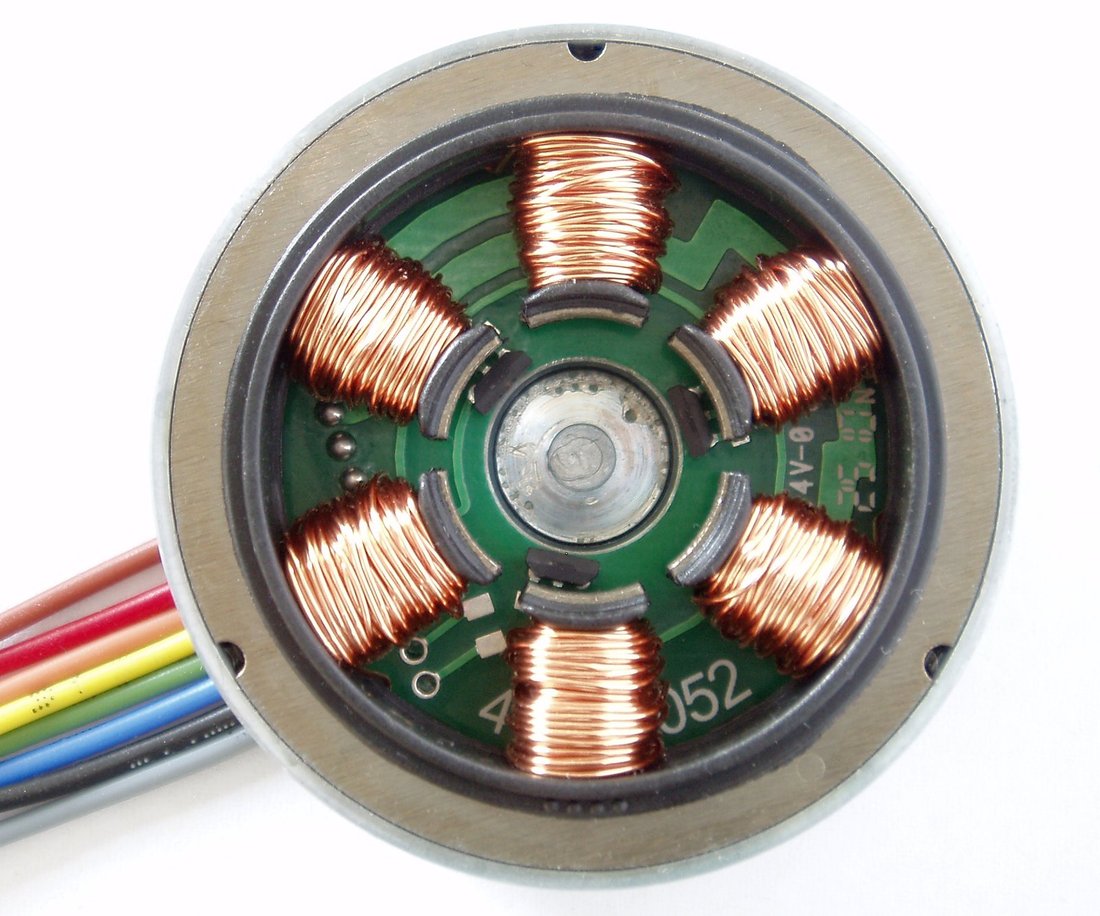
Most electric motors have a stator: the stationary part that carries the copper windings, usually built on a stack of laminated steel. How those windings get into the stator is one of the oldest problems in coil winding, and one of the newest, because electric vehicle motors have pushed winding technology into a new generation. This article explains the main winding methods and why the hairpin has become the industry's talking point.
Two basic winding layouts
Motor windings fall into two broad layouts. A distributed winding spreads each phase's coils across many slots; it is the classic arrangement in industrial induction motors and, with a suitable design, produces a smooth rotating magnetic field. A concentrated winding places a separate coil around each stator tooth, as in the brushless DC stator pictured above. Concentrated windings are compact and well suited to automated single-tooth winding. Distributed windings can offer smoother operation, but their coils take more work to insert.
Round-wire methods
For round enameled copper wire, three machine methods are in wide use.
Needle winding uses a nozzle that moves in and out through the stator bore, laying wire directly around each tooth or into each slot. It is commonly used for concentrated windings, especially when the winding must be tight and precise.
Flyer winding rotates a flyer arm around the tooth, wrapping wire at high speed. It suits smaller stators and rotors, and is common in products like power-tool and appliance motors.
Insertion is the traditional route for distributed windings. Coils are first wound on a form, and insulating liners are placed in the stator slots. An insertion machine then pulls or pushes the coils into the lined slots, followed by end-forming, lacing and impregnation.
The hairpin change
Traction motors for electric vehicles increasingly use hairpin windings. Instead of round wire, the stator is filled with flat, rectangular enameled copper bars pre-formed into a hairpin shape. The manufacturing process is essentially an assembly process rather than classical winding, and a doctoral study of hairpin production technology breaks it into a long chain of steps:
- Straightening the wire as it comes off the spool.
- Removing the enamel at the points that will later be welded, usually by laser, with mechanical stripping as an alternative.
- Cutting the wire to length.
- Bending it into shape, first in two dimensions, then in three; CNC bending machines can do both on one machine.
- Insulating the stator slots with paper liners.
- Pre-assembling the hairpins in a basket outside the stator, then inserting the whole set into the laminated core.
- Necking and twisting the protruding wire ends into their final geometry.
- Connecting the ends, usually by laser welding, then re-insulating and testing the finished stator.
Why the industry is moving
The attraction is the slot fill factor: rectangular conductors pack copper into the slot far more densely than round wire, which raises efficiency and improves heat transfer out of the slot. The process is also well suited to automation. The drawbacks are real, as a 2026 review of hairpin design in Frontiers in Mechanical Engineering notes: the process chain is long, many steps still have significant potential for optimization, and weld quality depends on cleanly stripped, uniformly positioned wire ends. Choice of hairpin layout also affects losses at high speed, so winding design and process design now go hand in hand.
For winding equipment builders, the message is that hairpin production now stands alongside the established round-wire methods as a distinct process in its own right.
Technical details are drawn from a doctoral dissertation on hairpin production technology at Friedrich-Alexander-Universität Erlangen-Nürnberg and a 2026 review of hairpin winding design in Frontiers in Mechanical Engineering, checked 25 November 2026. This article is not design or purchasing advice.
Image: concentrated windings on the stator of a small brushless DC motor (Micronel U65MX). Photo: Medvedev, CC BY-SA 3.0, via Wikimedia Commons; resized from the original.