
Inrush current: why a transformer gulps power the moment it is switched on
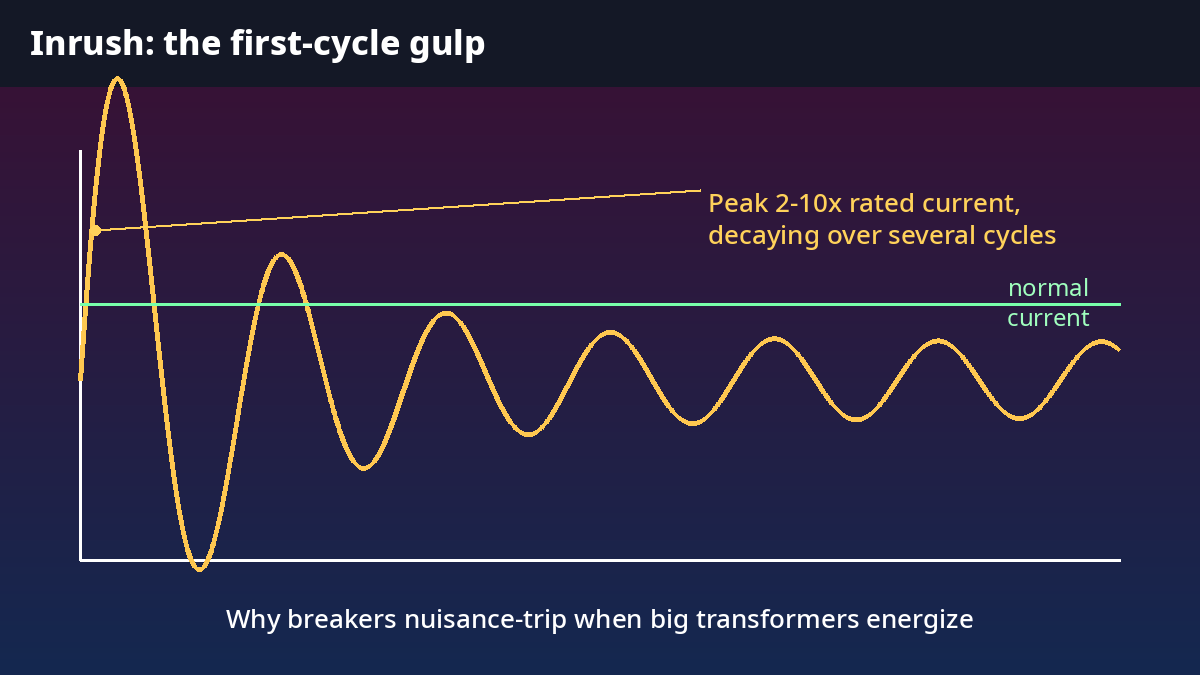
Switch on an unloaded transformer and, for a few cycles, it can behave like a short circuit. The magnetising inrush current commonly reaches two to ten times the transformer's rated full-load current, occasionally more, before decaying over a handful of cycles to the small no-load current the theory books describe. Nothing is wrong with the transformer. It is physics, arriving on schedule.
Where the surge comes from
A transformer's core flux must follow the applied voltage: the integral of voltage over time. If the transformer is energised at the peak of the voltage wave, the required flux starts from zero and swings symmetrically, and nothing dramatic happens. Energise at the voltage zero crossing instead and the flux must swing to twice its normal peak to keep up with the integral. Add the residual flux left in the core from the last time it was switched off, which can be a substantial fraction of the normal peak, and the total demanded flux can exceed twice the working level. The core saturates.
In saturation the core's permeability collapses toward that of air, the magnetising inductance falls off a cliff, and the only thing limiting current is the winding resistance and system impedance. Hence the gulping current spike, rich in second-harmonic content, decaying as the flux recentres over several cycles.
Why protection does not just trip it off
An inrush looks, to a simple protective relay, very like a fault current. Differential protection distinguishes them mainly by that second-harmonic signature: fault currents are nearly pure fundamental, while inrush is laced with second harmonic, so relays restrain on it. Getting this wrong in either direction is expensive; a false trip blackouts a healthy transformer, while a blind relay misses a real fault.
The sympathetic cousin
Inrush does not always stay with the transformer being switched. When a new transformer is energised in parallel with one already in service, the DC offset in the inrush can push the running unit into saturation too, producing a sympathetic inrush in its current. Protection schemes and switching sequences in substations are designed with this domino effect in mind.
Taming it
Several practical mitigations exist. Controlled switching, closing each phase at the favourable point on the wave with knowledge of the residual flux, removes most of the surge and is standard practice on large units. Pre-insertion resistors absorb the energy for a few cycles during energisation. Sizing fuses and breaker settings with time-delay to ride through the decay handles it on smaller transformers. Toroidal cores, with their near-gapless magnetic path, tend to show the effect more strongly, which is one reason small toroidal transformers so often blow fast fuses at switch-on. The phenomenon is a good reminder that a transformer's steady-state reputation hides a rowdy first few cycles.