
The 20,000-hour promise: how thermal classes are actually tested
The letter on the nameplate, as our guide to insulation classes explains, is a temperature promise: class F means the hottest spot in the winding may sit at 155 degrees C and still deliver a normal service life. But nobody tests a motor for twenty years to check. The promise rests on one of the oldest and most elegant procedures in electrical engineering: accelerated thermal aging.
The logic of aging faster
Insulation ages by chemistry: oxidation, scission of polymer chains, loss of plasticisers. Chemical reaction rates climb steeply with temperature, a relationship described by the Arrhenius equation, and for the organic materials in windings a useful rule of thumb emerges: life roughly halves for every 10 degrees C of extra temperature. That steep dependence is the lever. If a material must last 20,000 hours at 155 degrees C, running it at 185 or 195 compresses the same aging into weeks or months of oven time.
How a test programme runs
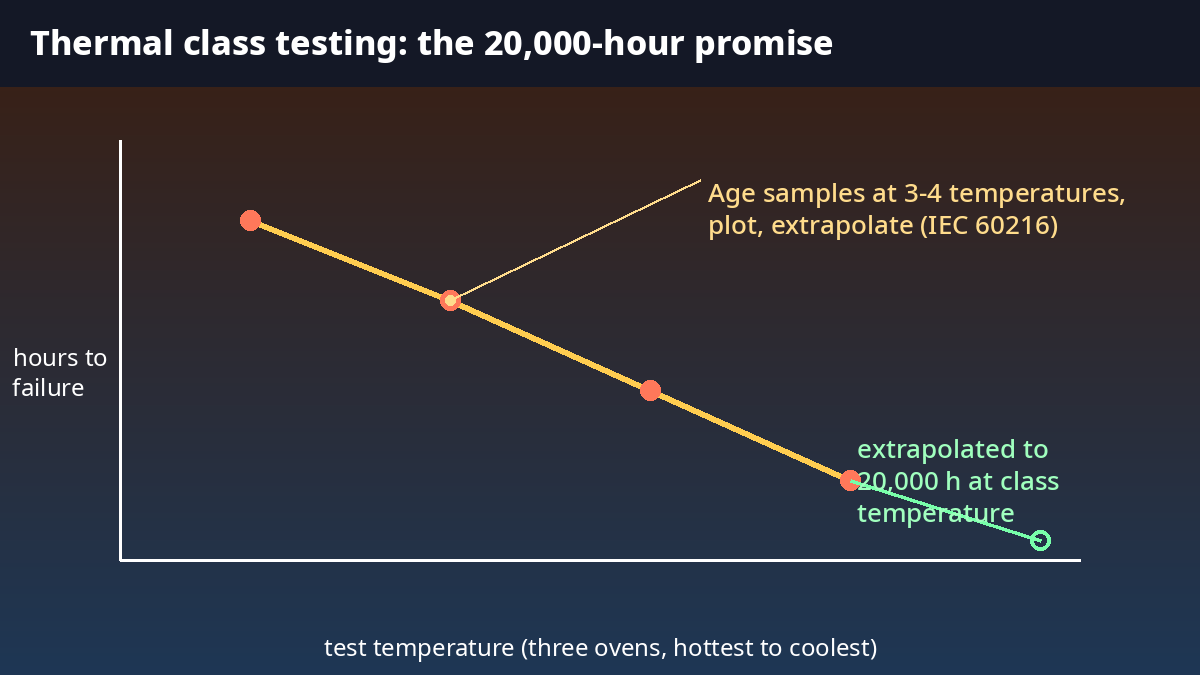
A thermal endurance programme builds model specimens, typically twisted pairs of enamelled wire or full motorettes, small assemblies that reproduce the winding's insulation system, and distributes them across several ovens held at different temperatures above the class temperature. Groups of specimens come out on a schedule and face a proof stress: a voltage withstand check, a mechanical flex, a moisture exposure. An oven's group has "failed" when its specimens can no longer pass. The result is a set of times-to-failure at several temperatures.
The extrapolation
Plotted as the logarithm of life against inverse absolute temperature, the Arrhenius relationship falls on a straight line. Extrapolating that line to 20,000 hours yields the temperature index: the temperature at which the material or system should survive those 20,000 hours. That number, rounded to its class step, is what becomes the letter. The whole framework, including how many specimens, which proof tests and how to treat the statistics, lives in the IEC 60216 series for materials and in system-level procedures referenced by IEC 60085.
Systems, not just materials
A subtlety matters to winding shops: the class belongs to the insulation system, the combination of enamel, tapes, resin and process, not to any one ingredient. Two class F wires with the wrong impregnating varnish can underperform as a system, because the chemistry interacts. That is why motor repair standards insist on documented, tested systems, and why a rewind that swaps one component for an untested equivalent has quietly invalidated the nameplate's promise.
Why it endures
Accelerated aging has critics: real machines see thermal cycling, vibration, voltage stress and contamination together, not a clean oven. Modern work adds those multi-factor stresses. But the Arrhenius framework has ordered the industry for decades because it turns an unmanageable question, will this winding outlive its machine, into a measurable, comparable number. The little letter carries a long experiment behind it.