
Superconducting coils: the wire that carries current forever
Every coil in this publication fights resistance: copper losses, heating, efficiency. One family of windings simply does not have it. Cooled below its critical temperature, a superconducting wire carries current with exactly zero electrical resistance, and the magnets wound from it are among the most demanding coil products in existence. Their most familiar home is the MRI scanner.
The wire inside the wire
The workhorse material is niobium-titanium, an alloy that superconducts below about 9 kelvin. It cannot be used as a plain solid strand: for stability it is drawn into filaments finer than a human hair, dozens to thousands of them, embedded in a matrix of high-purity copper. The copper carries the current briefly if a spot of superconductor warms and quenches back to normal, giving the magnet a chance to survive its own stored energy. The finished wire looks ordinary; the metallurgy inside it is anything but.
Persistent mode: the perpetual current
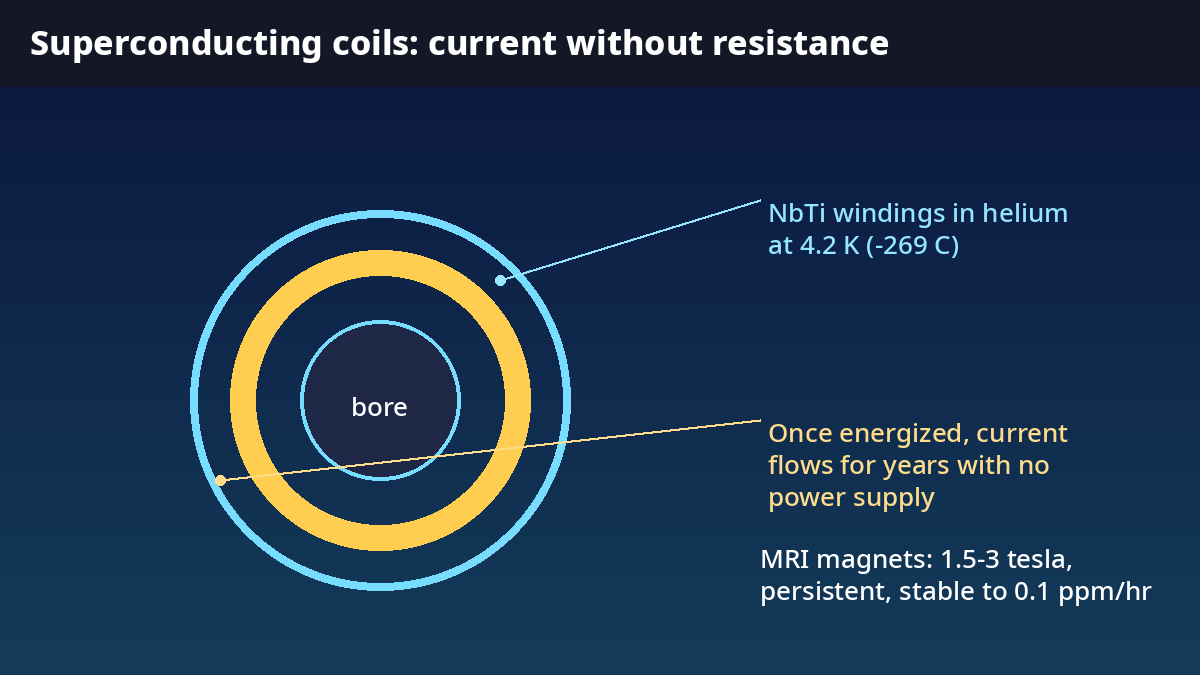
An MRI main magnet is a large solenoid wound from NbTi wire, immersed in a bath of liquid helium at 4.2 kelvin inside nested cryostat shields. To energise it, technicians warm a small superconducting switch across the coil, drive current in from a power supply, then cool the switch back to superconducting and remove the supply. The current now circulates in a closed loop with no resistance and nowhere to go: it simply persists, holding the field, 1.5 or 3 tesla in clinical systems, for years. No power supply runs it; the helium plant only replaces what boils away.
The quench: when it all comes back at once
Persistence has a dramatic failure mode. If any part of the winding warms past its critical point, a mechanical disturbance, a helium shortfall, that section goes resistive, heats its neighbours, and the magnet quenches: the entire stored energy, megajoules in a clinical magnet, converts to heat in seconds and boils the helium off in a plume through the vent system. Quench design is therefore part of the winding: detection, heaters that spread the energy evenly, and vents sized for the gas. A controlled quench is survivable; an uncontrolled one can destroy the coil.
Winding the unwinding
Producing these coils stretches every winding skill. The wire is brittle in performance terms: bending strain degrades the filaments, so bend radii are controlled. Turn placement must be precise, because field uniformity is specified in parts per million over the imaging volume, and every joint between wire lengths must itself be superconducting, made with solder techniques specific to the alloy. Insulation must survive cryogenic cycling without cracking.
Beyond the hospital
The same wire family powers research magnets, particle accelerators and fusion experiments, while newer high-temperature superconducting tapes loosen the helium requirement. But the essential marvel is unchanged since the first persistent magnets: wind the coil, cool it, charge it, and the current outlasts the power supply, the building's wiring, and sometimes the careers of the people who wound it.