
Solenoids and relays: the coils that move the world
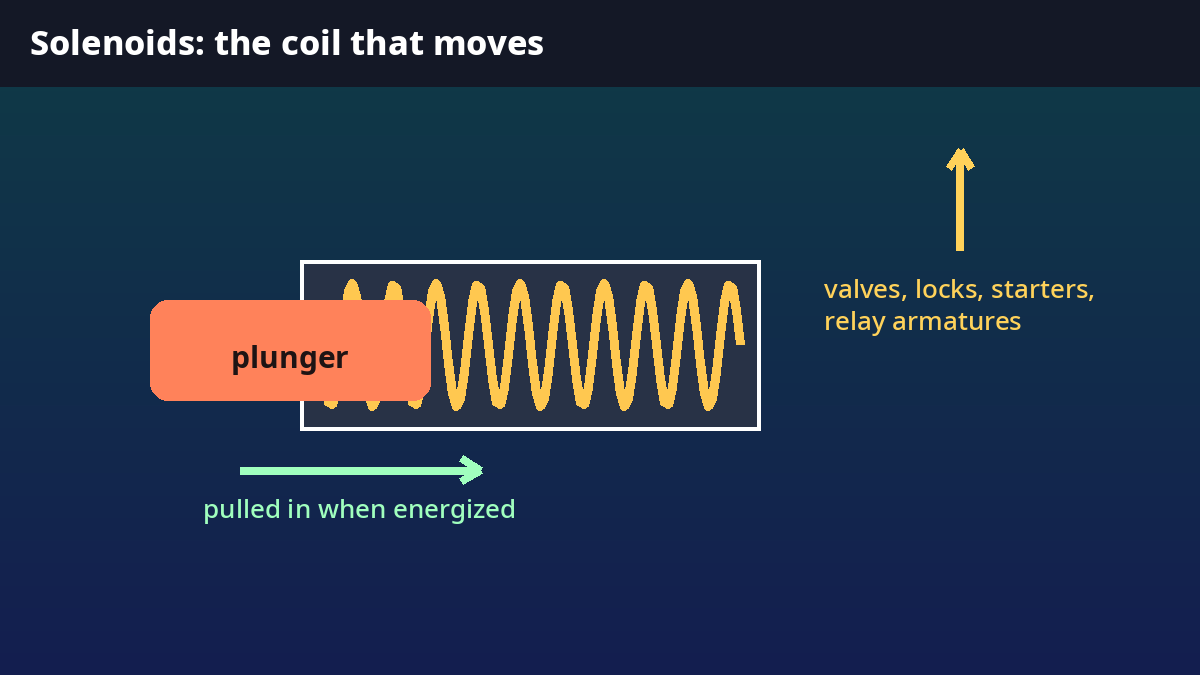
Most coils are built to sit still and shape magnetic fields. A solenoid is built to move. Energise its winding and a steel plunger is pulled into the coil's centre with enough force to throw a lock bolt, open a valve or slam a set of contacts together. It is the simplest electrical actuator there is: a coil, a frame and a piece of iron.
How the pull happens
A current-carrying coil produces a magnetic field along its axis. Put a ferromagnetic plunger at the mouth of the coil and the field magnetises it; the plunger is drawn toward the centre of the coil, where the field is strongest, because the magnetic circuit's reluctance drops as the plunger seats. The pull is strongest near the end of the stroke and weaker when the plunger is far out, a force curve every solenoid datasheet plots. The stationary frame of steel around the coil closes the magnetic circuit and roughly doubles the available force compared with a bare coil.
Relays and contactors: solenoids that switch
Add a set of contacts to the plunger and the solenoid becomes a relay: a small current in the coil switches a larger current at the contacts, with galvanic isolation between the two as a bonus. Scale the same idea up and reinforce the contacts against arcing, and you have a contactor, the workhorse that switches motors and heater banks. The genealogy is direct: coil, plunger, spring, contacts.
The AC coil quirk
Coils driven from AC have a characteristic trap. While the plunger is out, the magnetic circuit has a large air gap, so the coil's inductance is low and it draws several times its sealed current. If the plunger cannot seat, because of dirt, a bent armature or low voltage, the coil sits at that high current and cooks. A buzzing relay that never quite pulls in is a coil minutes from failure. AC contactors add a shading ring, a shorted copper loop in the pole face, to keep the field from collapsing to zero twice per cycle and stop the contacts from chattering.
Duty cycle matters
A solenoid rated for intermittent duty can pull hard for seconds at a time; ask it to hold for hours and it will overheat. Holding force needs far less current than pulling force, so some designs use a strong pull-in winding and a weak hold winding, switching between them at the end of the stroke. Door locks, pinball flippers, starter solenoids and vending mechanisms all live on that distinction.
Why they persist
In an age of electronic everything, the solenoid survives because it converts electricity to linear force with one moving part, no semiconductor in sight, in milliseconds. Wherever something physical must snap from here to there when a coil is energised, the cheapest reliable answer is still a winding and a lump of iron.