
How a metal detector's coils see through soil
Swing a metal detector over a beach and it will find a coin buried a hand's depth in sand, ignore the sand itself, and take a reasonable guess at whether the target is a pull-tab or a gold ring. All of that is done with coils: one to broadcast a magnetic field into the ground, one to listen for what the field wakes up.
The eddy-current principle
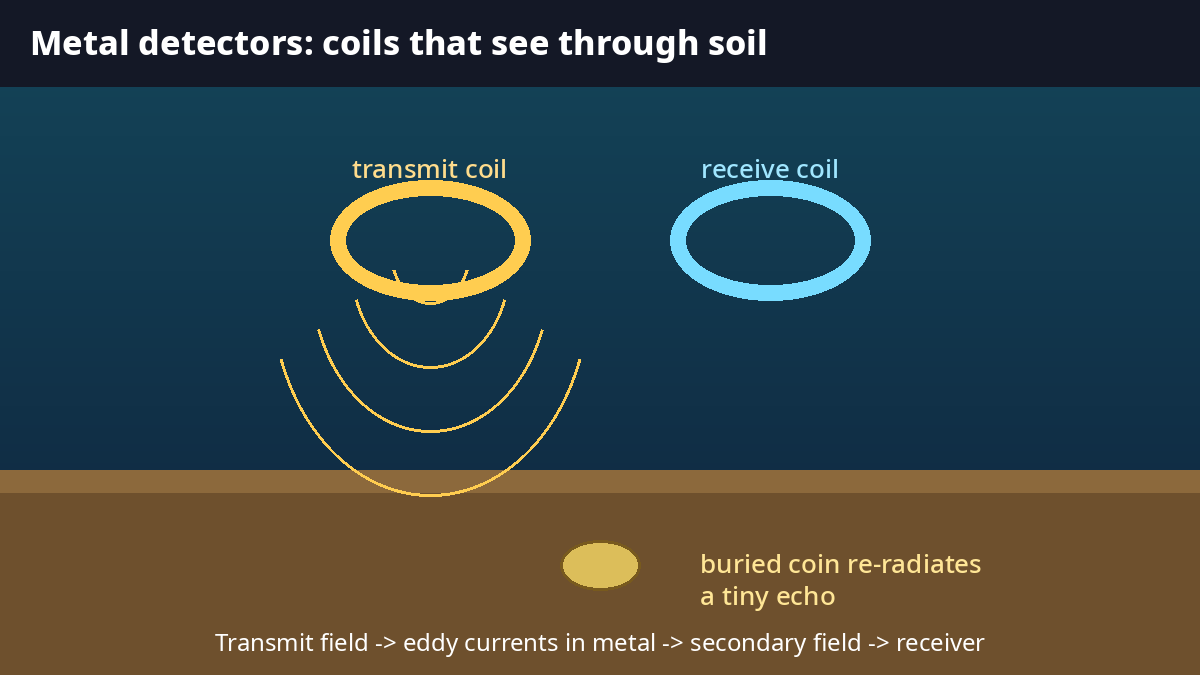
The transmit coil carries an alternating current, typically at a few kilohertz to a few tens of kilohertz, and broadcasts an alternating magnetic field into the soil. Any conductive object in that field has eddy currents induced in it, and those currents generate their own, opposing magnetic field. The receive coil picks up that faint secondary field. Sand, rock and salt-free soil are poor conductors and stay quiet; metal answers back.
The receive signal is vanishingly small next to the transmit field, so the classic very-low-frequency design arranges the coils in an induction balance: the transmit and receive windings overlap in a geometry where the direct coupling between them cancels to near zero. Anything that disturbs the balance, a coin breaking the symmetry, shows up as a signal. Getting that null right is a winding problem: coil shape, spacing and turn counts are adjusted until the empty-ground reading is as close to zero as the mechanics allow.
Telling metals apart
The return signal carries more than presence. Its phase, relative to the transmitted field, depends on the target's mix of conductivity and magnetic permeability. Ferrous objects, being magnetic, shift the phase one way; highly conductive non-ferrous metals like silver and copper shift it another; thin, poorly conducting foil sits between. The detector measures that phase to discriminate, letting the user ignore iron nails while digging coins. Multi-frequency machines repeat the measurement at several frequencies at once to sharpen the classification.
Coil size is a design dial
The search head's geometry sets the instrument's character. Large coils, dinner-plate size and up, project their field deeper and suit relic and cache hunting, but they lose sensitivity to tiny targets and struggle in trashy ground where several objects fall inside the field at once. Small coils, down to a few inches, sharpen up on fine gold and cluttered sites at the cost of depth. Double-D coil shapes give a blade-like detection pattern with good ground coverage, while concentric coils offer a symmetrical cone that pinpoints cleanly.
The industrial relatives
The same physics, minus the beach, works in industry: conveyor-line detectors that reject tramp metal from food and textiles, eddy-current probes that find fatigue cracks in aircraft skin, and the security arches at airports. Each is a coil, a field, and something conductive that should not be there, or should. The winding shop's contribution is unglamorous and decisive: stable, balanced coils that hold their null through temperature, vibration and time.