

Current Transformer Windings: Construction and Parameters
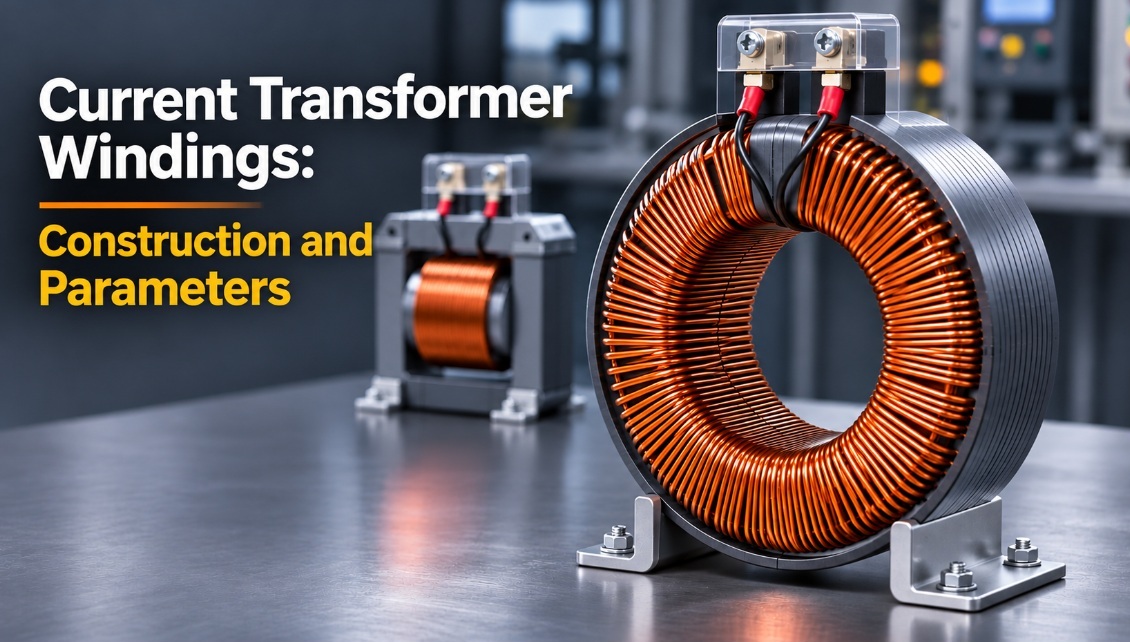
A current transformer, or CT, provides a current at a useable level to monitor the current in a circuit. A manufacturer guide gives an example: it is not economical to have an ammeter to measure 600 amps in a conductor directly, but it is economical to have one that reads 0 to 5 amps, so a CT is inserted to produce a current proportional to the line current.
Construction
CR Magnetics describes three main designs. All have a magnetic core and one or more windings.
- Toroidal, or window type. It has no internal primary winding. The primary is the conductor being monitored, placed through the window. The core is a band of magnetic grade steel wound on itself. This type is common and the ratio can be adjusted with ease.
- Wound primary. It has an internal primary winding and no window. The maker says the designer can give low-current ratios better accuracy and burden capability, but the primary is inserted in series with the conductor, which is intrusive.
- Bar type. A toroidal transformer with a bus bar as an integral part, permanently through the window. The maker notes it is a common error to call a wound primary a bar type because its connections are made to bus bars.
The ABB application guide shows the same window, bar and wound forms. Variations include tapped windings, multiple windings and cores, multi-ratio units with a tapped secondary, and split-core units that can be installed without opening the circuit.
Ratio
The ratio is written as primary current to secondary current, such as 100:5 A. CR Magnetics gives an example for a 480 V motor with 96 A full load current: a 100:5 CT would work but would sit at the upper limit of a 0 to 100 A meter, so 150:5 A is a better choice. On a toroidal CT the ratio can be adjusted coarsely by passing the primary conductor through the window more than once. Its example: two primary turns on a 100:5 CT give a 50:5 ratio.
Burden and accuracy
- Burden is the load on the secondary. The maker says to consider the total burden: the CT secondary winding, the leads and the instrument. The CT must give its required accuracy at that total.
- For a CT with a 5 A secondary, ohms can be converted to VA by multiplying by 25, so the ANSI burden B0.2 is 5 VA.
- A metering class such as 0.3B0.2 means the ratio error does not exceed 0.3 percent at a burden not exceeding 0.2 ohm. ANSI relay classes require that the ratio error does not exceed 10 percent.
What to check
- Voltage class of the circuit.
- Primary current and the ratio.
- Accuracy needed. A panel meter with 2 to 3 percent accuracy needs only a 0.6 to 1.2 percent CT, per the maker.
- Total burden.
- Type: window, wound or bar, and whether split core is needed.
- The maker's instructions for connecting and protecting the secondary circuit.
For basic transformer windings see transformer windings.
Frequently asked questions
What does a CT do?
It produces a small current proportional to a large line current, for meters and relays.
What are the main types?
Toroidal or window type, wound primary and bar type.
What is burden?
The load on the secondary, including the CT winding, the leads and the instrument.
How is the ratio written?
Primary amps to secondary amps, for example 150:5.
Can I change the ratio?
On a toroidal CT, passing the primary through the window more than once changes the ratio.
Sources
- CR Magnetics: instrument transformers application guide (current transformer types, ratio, burden, accuracy)
- ABB: instrument transformers technical information and application guide (window, bar and wound types)